

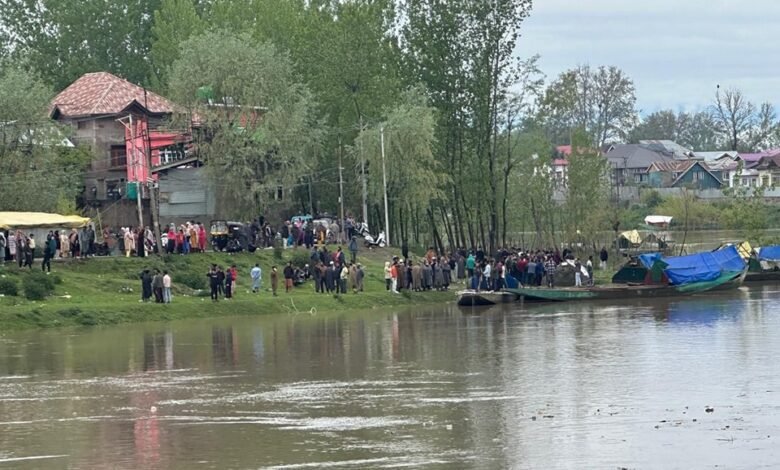
Srinagar, Sep 4, KNT: Every spell of heavy rain in Kashmir revives the spectre of floods, triggering panic among locals who still recall the devastation of 2014. While authorities often attribute the recurring scare to natural causes, locals and experts insist the real culprits are unchecked encroachments, vote-bank politics, and the failure of successive governments to safeguard flood channels and wetlands.
A couple of flood management experts while talking to the news agency Kashmir News Trust, said that the Jhelum’s natural carrying capacity has been steadily compromised due to illegal construction along its banks and on adjoining flood channels. In several areas, land that legally belongs to the river has been encroached upon and converted into residential and commercial sites with official sanction or tacit approval.
One glaring example, experts point out, is the locality in Srinagar’s uptown, where land adjoining the Jhelum has been marred with buildings. Similarly, in Srinagar’s old city, an influential businessman was recently allowed to raise a shopping complex on a flood channel, only for the authorities to later seize it after public outcry. Locals question how such construction was permitted in the first place, and why responsibility is never fixed on the officials who enabled it.
“The story repeats itself everywhere. First, influential people are allowed to build on wetlands or flood channels. Then, when there is hue and cry, the structure is seized as a face-saving measure. But no one asks who gave permission, who signed the files, and why such constructions were tolerated for so long,” said a retired government official.
📢 8,000+ readers already joined for instant Kashmir News Trust updates
Environmentalists argue that the greed of some in-service and retired officials placed entire populations at risk. They say in order to benefit a handful of individuals, authorities have ruined natural drainage systems, restricted water flow, and made floods inevitable. “When a flood channel is blocked, the water has nowhere to go. The result is catastrophic for ordinary people who live far from these encroachments,” one expert noted.
The problem is not confined to Srinagar alone. In almost every district of the Valley, wetlands have been encroached upon or filled with earth for housing colonies, shopping complexes, and other construction. Localities along the Jhelum, Doodhganga, Rambiyara and Vishow Nallah have all witnessed rapid construction on fragile land that once absorbed excess water.
Locals say the government’s reluctance to act against influential builders is driven by political compulsions. “Vote-bank politics has overridden public safety. Until this mindset changes, floods will continue to haunt the Valley. It is not just nature’s fury; it is the price of misgovernance,” remarked a civil society activist in Srinagar.
Environmentalists also warn against the large-scale felling of trees which has worsened soil erosion and reduced natural water absorption. Together with blocked flood channels, the Valley now faces a situation where even a day or two of rainfall causes alarm.
Concerned citizens argue that accountability is the missing piece. “Floods are not only about rainfall; they are about policies. Unless those who allowed wetlands and flood channels to be turned into shopping complexes and colonies are punished, these disasters will keep returning,” said a local trader.
Despite repeated claims of “smart flood management” and “protecting wetlands,” ground realities remain unchanged. For most Kashmiris, the fear of floods is no longer an exceptional event but a recurring nightmare. [KNT]