
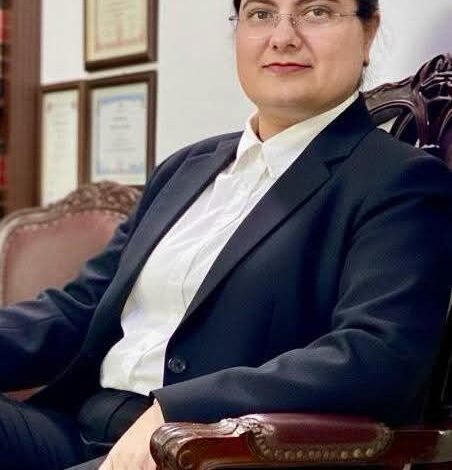
By Sheema Farooqi ~
Legal Commentator
There are moments when a legal dispute ceases to be merely about the person named in the petition.
📢 8,000+ readers already joined for instant Kashmir News Trust updates
It begins to ask larger questions.
Who owns an institution’s memory? How far can administrative authority travel into a religious tradition? Can an order intended to operate temporarily continue for years without a final determination? And when custom, faith, law and public administration intersect, who ensures that one does not casually erase the other?
These questions have acquired renewed relevance after Professor Dr Kamal-ud-Din Farooqi approached the High Court of Jammu & Kashmir and Ladakh challenging his continued exclusion from performing the duties of Imam-o-Khateeb at Aasar-i-Shareef Dargah Hazratbal.
The High Court has issued notice to the concerned authorities and has also directed consideration of his representation. The matter is before the Court, and therefore its merits must ultimately be determined judicially.
But Hazratbal deserves a conversation larger than litigation.
For Kashmiris, Hazratbal is not simply another shrine administered through files, offices and regulations. It occupies a place within the spiritual imagination of generations. Its pulpit carries memory. Its rituals carry continuity. The people who have served there are therefore not merely occupants of administrative posts; they become part of an institution whose history belongs to the community itself.
That distinction matters.
An interim order cannot become an institution
The dispute traces itself to an incident on April 5, 2024, when an individual expressed his desire to embrace Islam during a large congregation at Hazratbal.
Much has since been said and written about that event.
What should matter today, however, is not rhetoric but process.
Dr Farooqi was relieved of his duties through an order dated April 8, 2024, pending an enquiry. The enquiry committee was reportedly required to submit its factual findings within seven days.
More than two years later, the central question is remarkably simple: what became of that enquiry?
If misconduct was established, an affected person was entitled to know the finding against him and to respond in accordance with law.
If misconduct was not established, an interim restraint could not reasonably acquire an indefinite existence merely because the administrative process remained incomplete.
According to the petition before the High Court, no final enquiry report or decision was communicated to Dr Farooqi. He maintains that he cooperated with the enquiry and submitted his statement.
The issue, therefore, is not whether an administration possesses regulatory authority. Every institution requires administration.
The more important question is whether administrative authority can remain unaccountable to the very procedure through which it chooses to act.
That question matters well beyond Hazratbal.
Temporary governmental or administrative action must remain temporary unless lawfully converted into a final determination. Otherwise, delay itself becomes punishment.
No democratic system should permit silence to become a substitute for an order.
The incident and the individual must also be separated
There is another important fact.
The police case arising from the events of April 2024 did not name Dr Kamal Farooqi as an accused.
Public controversies often have a peculiar tendency: the atmosphere surrounding an incident becomes indistinguishable from the legal responsibility of every person present within it.
Law is supposed to do precisely the opposite.
It separates allegation from evidence, association from responsibility and public perception from legal culpability.
That discipline becomes particularly important when religious institutions are involved, because decisions taken in emotionally charged circumstances can have consequences lasting far beyond the controversy that produced them.
The question before society should therefore never be whether we liked or disliked what occurred on a particular afternoon.
The question should be whether consequences imposed upon an individual or an institution were authorised by law, supported by findings, and arrived at through a fair process.
Hazratbal also carries the weight of custom
There is yet another dimension that a short news report cannot adequately capture.
The office of Imam-o-Khateeb at Hazratbal did not begin in 2024.
The Farooqi family’s association with the religious life of Aasar-i-Shareef stretches across generations and, according to the historical and family record relied upon in the petition, across several centuries.
My grandfather, Maulana Bashir Ahmad Farooqi, served the shrine as Imam-o-Khateeb until his passing. Dr Kamal Farooqi later continued that religious responsibility.
But the significance of this history should not be misunderstood.
The argument is not that ancestry creates immunity from law.
It does not.
Nor should religious office become an unquestionable private inheritance.
The point is subtler and constitutionally far more important.
Long-standing custom creates institutional meaning.
Where a religious office has developed through recognised practice over generations, that history cannot simply be treated as though the position were an ordinary contractual appointment terminable through an administrative note.
Custom does not stand above law.
But neither should administration behave as though custom has no existence.
Courts in India have repeatedly had to examine the relationship between religious practice, denominational autonomy, statutory regulation and secular administration. The constitutional values reflected in Articles 14, 21, 25 and 26 remind us that administrative control over religious institutions cannot become an unrestricted licence to determine religious life itself.
A Waqf authority unquestionably performs important statutory and administrative functions.
But administration of a shrine and ownership of its religious conscience are not necessarily the same thing.
Somewhere between those two lies the boundary that law must carefully preserve.
The pulpit is not a political trophy
There is another reason this case deserves thoughtful attention.
Religious institutions are at their strongest when their pulpits remain larger than governments, political parties and temporary office-holders.
Governments change.
Administrators change.
Boards are reconstituted.
Political climates change.
But institutions such as Hazratbal belong to a much longer chronology.
That is precisely why restraint is required from everyone who exercises authority over them.
No individual—Imam, administrator, politician or official—should imagine himself or herself larger than the institution.
The sanctity of Hazratbal requires checks on all sides.
A religious functionary must act responsibly.
An administrator must act lawfully.
The State must act constitutionally.
And where disagreement arises, the Court must remain free to examine the legality of what occurred without the matter being predetermined in television studios, political statements or social media campaigns.
That is institutional balance.
This is not a demand for privilege
As a member of this family, I am conscious that anything I write may be interpreted as personal.
Of course it is personal.
History becomes personal when the names in archival records are the names you heard around the dinner table as a child.
Tradition becomes personal when the pulpit under discussion was served by your grandfather and generations before him.
But being personally connected to history does not prevent one from asking a public question about law.
In fact, it imposes a greater obligation to ask it carefully.
I do not believe that any family should be above scrutiny.
I do believe that every person is entitled to fairness.
I do not argue that custom defeats statute.
I argue that lawful administration should understand the history of the institution it administers.
I do not ask that allegations be ignored.
I ask that they be determined.
And I do not believe an enquiry should produce a predetermined result.
I believe it should produce a result.
That distinction is at the heart of this dispute.
Why the High Court proceedings matter
The High Court has now sought responses from the authorities.
That is not a declaration of victory for either side. A notice is the beginning of judicial examination, not its conclusion.
That distinction should be respected.
The respondents will have an opportunity to place their position before the Court. The petitioner will have an opportunity to answer it. Questions concerning statutory authority, procedure, the enquiry, the nature of the religious office and the legality of continuing the restraint can then be examined through law rather than speculation.
Perhaps that is exactly where a controversy of this nature always belonged.
Because ultimately the Hazratbal dispute should not become a contest between personalities.
Its real significance lies elsewhere.
It asks whether administrative power carries an obligation to conclude what it begins.
It asks whether temporary action can become permanent through inaction.
It asks whether centuries of religious custom deserve consideration within contemporary statutory administration.
And, most importantly, it asks whether institutions of faith can remain protected from both arbitrary authority and personalised control.
Hazratbal has witnessed generations come and go.
Governments have risen and fallen around it. Administrations have changed. Kashmir itself has travelled through extraordinary periods of history.
Yet the shrine has remained.
That permanence should teach us something.
Those who serve an institution are temporary.
Those who administer it are temporary.
Those who litigate about it are temporary.
The institution is larger than all of us.
The task of law is not to choose between its past and its present.
It is to ensure that neither is erased without reason…..[Views expressed by author are her own]