
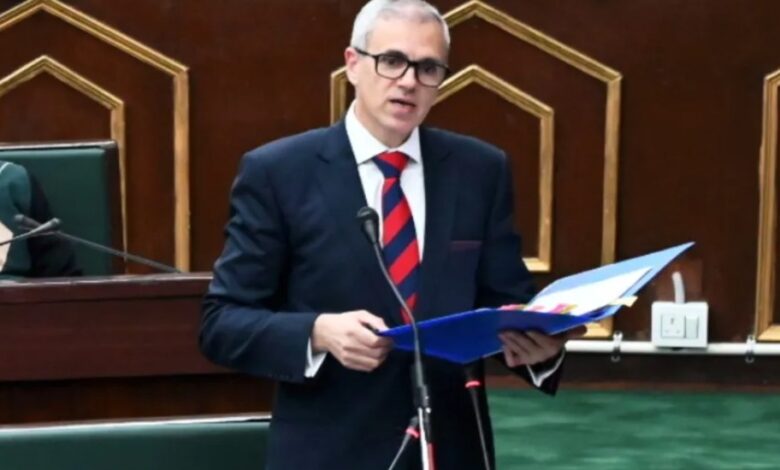
Srinagar, Oct 16, KNT: As the Omar Abdullah-led government completed one year in office, its journey has been marked by both hope and helplessness, with the elected leadership repeatedly asserting that its powers remain limited under the existing administrative framework. Despite securing a clear mandate in last year’s Assembly elections, the National Conference-led government continues to face constraints posed by dual governance, where key files and decisions rest with the office of the Lieutenant Governor (LG).
Chief Minister Omar Abdullah, who took oath on October 16, 2024, amid promises of restoring statehood and political dignity, has admitted on several occasions that his government is unable to function freely. “We want to deliver on our commitments, but decisions often get delayed because files do not return,” he reportedly told his party legislators during a recent review meeting.

Sources within the government say the Lt Governor’s office continues to retain control over several critical departments, including law and order, land management, and administrative rules. Deputy Chief Minister Surinder Chowdary has repeatedly requested LG Manoj Sinha to return files related to the Business Rules, which would define the operational authority of the elected government. However, despite several reminders, the files have not been cleared so far.
Legislators from the National Conference have also voiced concern over their limited authority. One senior NC leader said, “We were elected to govern, but in reality, it feels like we are only running a ceremonial government. The bureaucrats make the decisions, while we face the people’s anger.”
📢 8,000+ readers already joined for instant Kashmir News Trust updates
Opposition parties have seized on the growing perception of administrative paralysis. Peoples Democratic Party president Mehbooba Mufti recently said that the government’s silence on critical political and governance issues “betrays the people’s expectations.” Other parties, including the Apni Party and People’s Conference, have accused the government of being “unable to assert itself” despite having a democratic mandate.
 The government’s difficulties are compounded by a slowing economy, rising unemployment, and an administrative disconnect between civil secretariat departments and the chief minister’s office. Senior bureaucrats continue to dominate policy matters, while elected ministers complain of being sidelined in key decisions.
While Omar Abdullah maintains that he is determined to bring meaningful change, his efforts have been repeatedly undermined by the centralized administrative structure. His government demands the restoration of full statehood, but progress has remained limited to symbolic gestures.
In his recent public address, Omar Abdullah said, “We are not here to complain but to serve. However, it is a fact that our powers are restricted. Files are delayed, approvals are withheld, and our mandate is constantly tested. But we will continue to work within the system for the people of Jammu and Kashmir.”
A senior Journalist told the news agency Kashmir News Trust that the situation reflects a broader governance dilemma in Jammu and Kashmir, where an elected government and an unelected authority continue to function side by side. While the LG’s office insists that only the police and security apparatus remain under its control, ministers in the elected government claim otherwise.

Political analysts believe the ongoing tug-of-war between the LG administration and the elected government has not only slowed policy execution but also eroded public confidence. “The people voted for self-governance, but what they see is bureaucratic dominance,” an analyst said.
For now, the Omar Abdullah government continues to walk a tightrope, caught between a popular mandate it cannot fully exercise and an administrative structure that refuses to loosen its grip. Despite his visible frustration, the chief minister remains committed to what he calls a “long struggle” for the restoration of statehood and dignity for the people of Jammu and Kashmir. [KNT]