
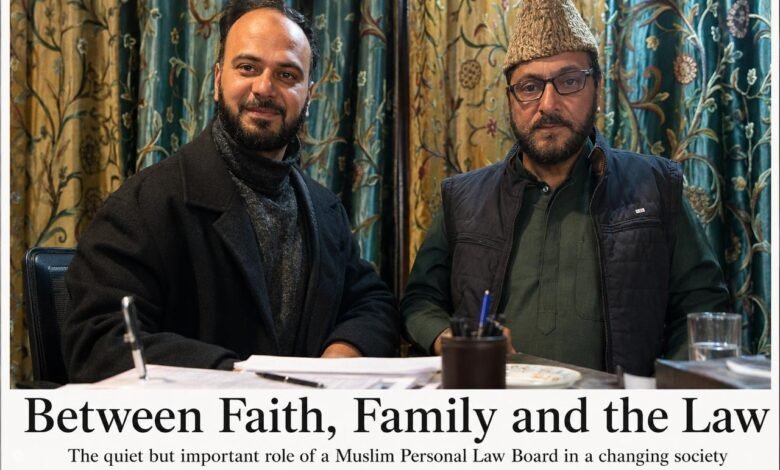
Between Faith, Family and the Law
The quiet but important role of a Muslim Personal Law Board in a changing society

By Sheema Farooqi
Writer and Commentator on Law, Communication & Public Affairs
Family disputes rarely begin as legal disputes. They begin around dinner tables, inside homes, and between people who once trusted one another.
📢 8,000+ readers already joined for instant Kashmir News Trust updates
Questions of marriage, divorce, inheritance, maintenance or family disputes may appear straightforward on paper, but for the people experiencing them, they are rarely just legal questions. They carry relationships, faith, emotions, traditions and sometimes generations of misunderstanding.
This is where an institution like the Muslim Personal Law Board can matter.
Its purpose should not be to stand in place of a court, nor to tell people how to live their lives. Its greater purpose is to create a space where people can seek guidance, understand their rights and, where possible, resolve differences with dignity before they turn into battles.
In Jammu and Kashmir, such an institution has particular relevance. Ours is a society deeply connected with faith and tradition. But traditions also need conversation with changing times. Young people ask different questions today. Women are increasingly conscious of rights that may once have gone unspoken. Families are changing, and so are the problems they face.
For a Personal Law Board to remain meaningful, it must also be willing to listen to these changing voices.
It should bring religious scholars and legal minds together. It should make complicated issues understandable to ordinary people. Most importantly, its doors should remain open not only to those seeking religious guidance, but also to those who simply need to be heard.
This makes the leadership of Grand Mufti Nasir-ul-Islam important. His scholarship and experience provide the Board with religious guidance and continuity. Alongside him, Advisor Danish Reshi has been working towards strengthening the institution, expanding its outreach and bringing greater engagement to its functioning. Such efforts deserve appreciation because institutions do not grow through titles alone; they grow when people invest themselves in the work.
There is also an opportunity here to imagine something larger.
A strong Muslim Personal Law Board can become a place for awareness, counselling, dialogue and mediation. It can help a young woman understand her rights, guide a family struggling with an inheritance dispute, counsel a couple before a disagreement becomes irreversible, and explain where religious guidance ends and the remedies of law begin.
That is meaningful community service.
Ultimately, the strength of an institution is not measured by how loudly it speaks, but by how patiently it listens and how many people feel they can approach it without fear or hesitation.
For the Muslim Personal Law Board of Jammu and Kashmir, this is perhaps the larger opportunity: to become more than a guardian of personal law—to become an institution people instinctively turn to for guidance, understanding and fairness.
And ultimately, a place of trust.